Unit 3 – Work, Energy, and Power
3.1 Translational Kinetic Energy
Kinetic energy refers to the energy of an object’s motion.
Claim: “if you double a block’s speed, its kinetic energy will double”
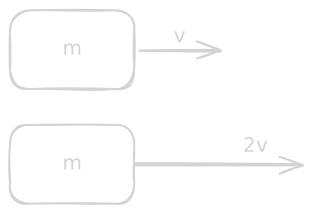
The claim is incorrect. The block will have four times the kinetic energy.
3.2 Work
Work is mechanical energy transferred into or out of a system. Work is the force times the distance.
is the force exerted on the system, is the distance over with the force is exerted, is the angle between the force and the distance.
The area under a Force vs Distance graph is the work.
Work is equal to the change in kinetic energy.
3.3 Potential Energy
Elastic Potential Energy
Elastic potential energy is potential energy stored in an ideal spring.
is the scalar amount of jules. is the spring constant. is the distance the spring has been stretched or compressed from its equilibrium length.
Local Gravitational Potential Energy
Gravitational potential energy () is the potential energy caused by an object’s change in position in a gravitational field.
Total Gravitational Potential Energy
Similar to the Gravitational Force equation, the potential energy of objects very far from earth have a different equation.
3.4 Conservation of Energy
The sum of , , and will remain the same in a closed system.

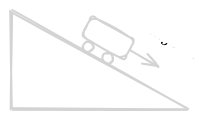
How fast is the car traveling at ?
How fast is the car traveling at ?
Practice Question
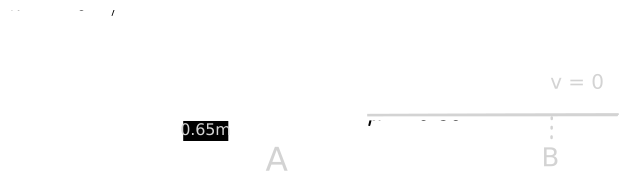
A block is attached to a spring as shown below and released from rest. At point , the block leaves the spring and slides over a rough surface before coming to a stop at point .
What is the speed of the block at point A?
What is the distance between point A and point B?
3.5 Power
Work is the amount of mechanical energy transferred into or out of a system. Power is the rate at which work is done or the rate at which energy changes.
Unit: watt ()
Example Question
A student collects the following data, determine how much power was used in the first travel to travel up the stairs.
| Trial 1 | |
|---|---|
| Mass of person | |
| Time | |
| Number of stairs | |
| Step height |